
How much data can one eSIM profile use before you need to switch?
One eSIM profile can use the data allowed by its provider's plan; there is no universal adapter-imposed allowance that tells you when to switch. The separate limits are plan validity, coverage and any fair-use restrictions, so running out of data does not automatically mean you need another profile. This 2026 guide separates those limits from adapter storage and explains when to top up, renew or switch.
- The esim adapter data limit per profile comes from the provider's plan, not its profile-storage slot.
- Switchesim eSIM adapters suit compatible physical-SIM devices; they do not increase a provider's data allowance.
- Switch Max stores up to 15 profiles, according to Switchesim; that is storage capacity, not a data allowance.
- Check remaining data, validity and coverage before switching or deleting an installed profile.
Why this matters
Buying more profile storage does not buy more mobile data. An adapter stores the credentials your device uses to connect to a mobile service. Your provider determines the allowance and conditions attached to that service.
That distinction prevents an unnecessary hardware purchase when your actual problem is an exhausted or expired plan. Check how long an eSIM profile stays active before it expires before treating a lost connection as a reason to replace the profile.
How much data can one eSIM profile use before you need to switch?
Keep using the same profile while its service remains usable under the provider's terms. Switch when another installed profile supplies the coverage or service you need and the current profile does not. If your provider supports adding data to the existing profile, switching is not necessary just because its original allowance runs out.
The following examples come from Switchesim's supplied product catalog. They illustrate advertised plan allowances, not a general hardware ceiling or a guarantee that every provider supports the same plans.
| Advertised plan example | Data allowance | Validity stated in the listing | Best for | Limitation to check |
|---|---|---|---|---|
| China mainland, Japan and South Korea | 10GB | 30 days | Comparing a smaller regional allowance | Activation trigger and exhaustion rules |
| China mainland, Japan and South Korea | 20GB | 30 days | Comparing more data over the same stated duration | Coverage and top-up eligibility |
| China mainland, Hong Kong and Macao | 50GB | 30 days | Comparing a larger allowance over a shorter period | Whether unused data expires |
| China mainland, Hong Kong and Macao | 50GB | 180 days | Comparing the same allowance over a longer period | When the validity period begins |
For your 2026 purchase, confirm the selected plan's current terms. A listing that states 50GB over 180 days does not establish a daily allowance, a renewal right or a reusable activation code.
10GB over 30 days: allowance and validity are separate
A listed 10GB allowance describes the plan's data quantity. The listed 30-day duration describes its validity, subject to the provider's activation rules. Neither figure describes how much information the adapter can store.
You need to check both conditions. An exhausted allowance and an expired validity period are different problems, even when both stop useful mobile-data service.
Best for: buyers comparing a smaller allowance over a stated monthly-length period. The benefit is a clearly stated quantity and duration; the limitation is that those figures alone do not explain top-ups, tethering rules or what happens after exhaustion.
20GB over 30 days: more data, not more profile slots
A listed 20GB plan has a larger stated allowance than a listed 10GB plan. Both regional examples above state 30 days. That comparison says nothing about how many profiles your adapter stores.
Do not choose higher-capacity hardware solely because you want a larger data plan. First establish whether your existing adapter, device and provider support the intended profile.
Best for: buyers who need to compare a larger allowance within the same stated duration. The advantage is the additional advertised data; the limitation remains the provider's coverage, validity and service restrictions.
50GB over 30 or 180 days: duration changes the decision
The supplied catalog includes 50GB plans with either 30-day or 180-day validity for China mainland, Hong Kong and Macao. The stated data quantity is the same. The stated duration differs.
A longer validity period does not establish faster speeds or a larger allowance. It gives you a different advertised period in which to use that allowance, subject to the plan's actual terms.
Best for: buyers comparing the same data quantity across different durations. The longer-duration option addresses a different usage window, but you still need to verify activation timing and whether the service covers your intended locations.
Why usable data per profile varies
The practical answer depends on the service attached to the profile. Read these conditions together rather than choosing from the headline allowance alone.
- Data allowance: The provider sets the included quantity. Adapter storage does not add to it.
- Validity: A plan's usage window can end independently of its remaining data. Confirm what starts that window.
- Coverage: Remaining data is useful only where the plan permits service and a supported network is available.
- Fair-use rules: Check whether the provider reduces speed or applies other restrictions after a usage threshold.
- Renewal and top-ups: The provider determines whether you can add service to the installed profile or need a replacement.
- Permitted use: Check tethering, router and other device-use restrictions before depending on the plan for shared connectivity.
For a 2026 comparison, record these terms beside each plan. A larger headline allowance is not a substitute for coverage in the place where you need to connect.
Check device fit before choosing an adapter
An adapter cannot fix a missing physical SIM slot or remove a carrier lock. Your target device needs a compatible physical SIM slot, and compatibility also depends on its model, regional variant, operating system, network bands and provider.
Separate loading a profile from using it. Managing profiles through the Switch Android app is not the same workflow as using a configured Max card in a compatible iPhone. The Bluetooth reader provides another provisioning path without requiring an Android phone.
| Hardware or setup path | Best for | Supported workflow stated by the brand | Benefit | Limitation |
|---|---|---|---|---|
| Switch Pro | Android-based profile management | Manage profiles through the Switch Android app | An Android management path | Verify the Android device and target-device fit |
| Switch Max | Compatible iPhone users and multi-profile users | Use a configured card in a compatible iPhone; Android use is also offered | Stores up to 15 profiles, according to the supplied listing | Requires a compatible physical SIM slot; storage does not enlarge a plan |
| Bluetooth reader | Provisioning without an Android phone | Loads profiles through the reader-based path | The listing states no app or account is required | It is a provisioning tool, not a mobile-data plan |
Switchesim eSIM adapters are best for users who need removable profile storage in a compatible physical-SIM device. Choose the management path first, then choose the data plan. Neither Switch Pro nor Switch Max substitutes for a provider subscription.
Pre-loaded destination-data cards provide another purchase format. Confirm the exact included plan rather than assuming every pre-loaded card has the same allowance. Bulk and white-label options address supply requirements; they do not establish different per-profile data entitlements.
How to decide whether to top up or switch
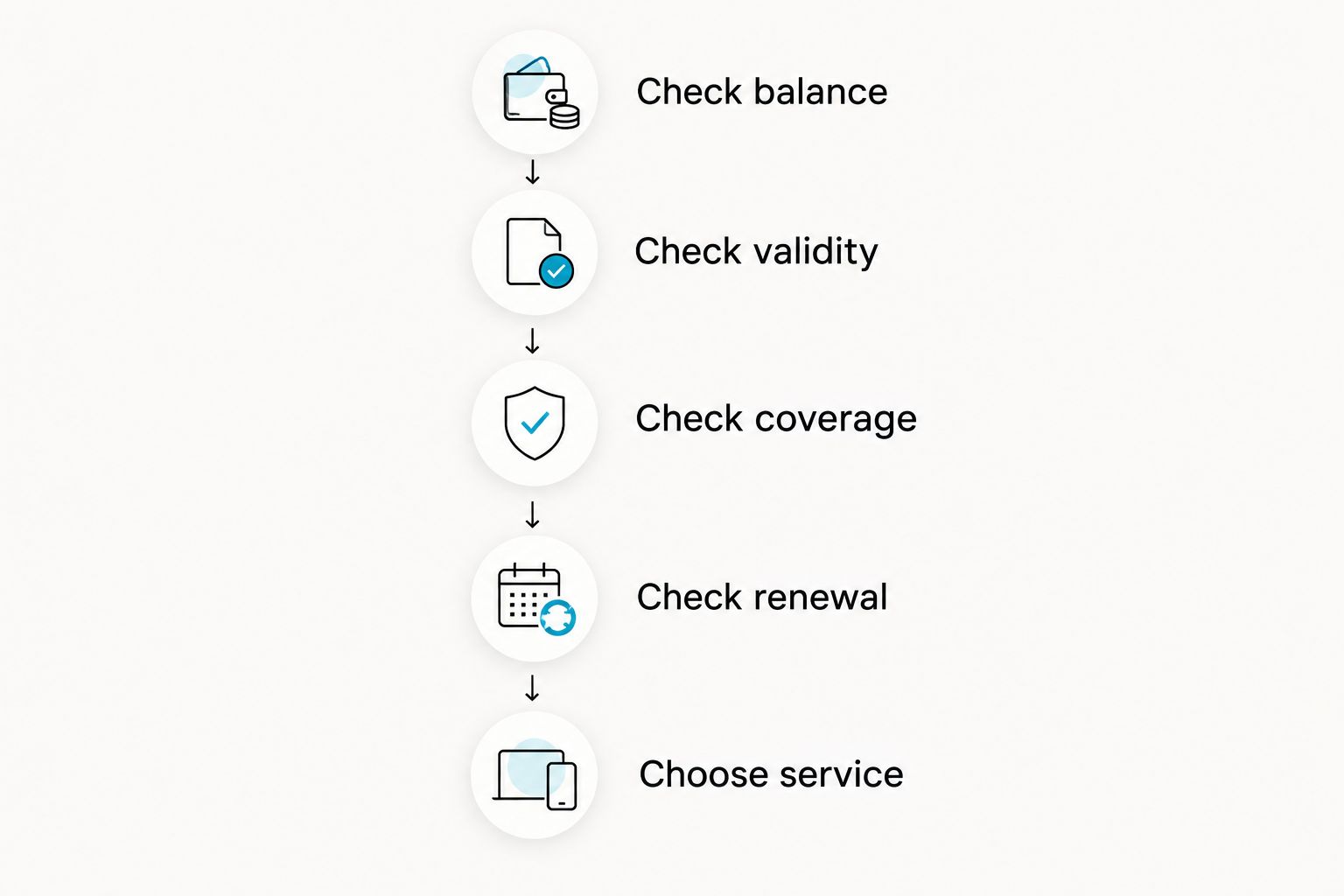
Use this sequence when your connection stops or your allowance gets low. It separates a service problem from a device or configuration problem without immediately deleting anything.
- Check balance. Open the provider's account or usage interface and inspect the allowance attached to the active service. Compare it with the phone's usage counter, but use the provider's records to understand the plan balance.
- Check validity. Confirm whether the plan is still within its usage window. Read the activation conditions rather than assuming the window began when you inserted the adapter.
- Check coverage. Verify that the plan covers your current location and that the device supports the required network. Remaining data does not resolve a coverage mismatch.
- Check renewal. Look for the provider's instructions for adding data or extending service on the existing profile. Do not assume a top-up requires another installation.
- Choose service. Keep the current profile if the provider can restore the service you need. Otherwise, select a suitable installed alternative or provision another supported profile.
Before you rely on this process in 2026, confirm how you will access the provider's account and your chosen profile-management method. Keep activation credentials private and accessible to you, not in a shared screenshot folder.
Can you keep the same profile after its data runs out?
Yes, if the provider supports continued service or a top-up on that profile. Exhausting the allowance does not by itself prove that the installed credentials must be replaced. Follow the provider's renewal instructions.
Do not delete the profile to test whether the allowance resets. Reinstallation does not create a new entitlement, and the provider determines whether an activation credential can be used again.
Does switching profiles reset your data allowance?
No. Switching profiles does not reset the provider's usage records. Returning to an exhausted plan does not restore its original allowance unless the provider has renewed or replenished that service.
A different profile can connect you to a different service entitlement. That is a change of service, not a reset of the original plan.
Does storing more profiles mean you can use more data at once?
No. Profile-storage capacity is not simultaneous connection capacity. The supplied Max listing states storage for up to 15 profiles; that number does not mean combined data allowances or concurrent connections.
Your device configuration and services determine how mobile data is used. Do not assume an adapter pools balances across providers or automatically selects a replacement when one plan ends.
Privacy and pre-purchase checks
The Bluetooth reader's supplied listing describes an open-source product requiring no app or account. That is a stated provisioning characteristic, not a promise that your mobile provider collects no information. Keep the hardware workflow and the carrier's privacy terms separate.
Before ordering hardware or a plan, confirm:
- Your exact device model, regional variant and operating system.
- A compatible physical SIM slot and acceptable carrier-lock status.
- The management path: Switch Android app, configured Max card or Bluetooth reader.
- The intended provider's activation method and adapter compatibility.
- The plan allowance, validity trigger, coverage and fair-use conditions.
- Top-up eligibility and the procedure for recovering or replacing a profile.
For a 2026 setup, retain those details with your order records. A clear compatibility answer is more useful than an unsupported promise that the hardware works with every phone.
FAQ
What's the eSIM adapter data limit per profile?
There is no universal eSIM adapter data limit per profile. The provider's plan determines the allowance, validity and service restrictions; profile-storage capacity is a separate hardware characteristic.
Do I need to switch profiles after using all my data?
Not if your provider supports adding service to the existing profile. Check the top-up or renewal instructions before installing or selecting another profile.
Will deleting and reinstalling my eSIM give me more data?
No. Deleting and reinstalling a profile does not create another data entitlement. Confirm whether the provider permits reinstallation before deleting anything.
Does Switch Max's profile capacity increase my data allowance?
No. Switch Max's stated capacity of up to 15 profiles describes storage, not an allowance. Each service remains subject to its provider's terms.
Can I use a configured Max card in an iPhone?
Yes, in a compatible iPhone with a physical SIM slot. Verify the exact model, regional variant, operating system, carrier-lock status and provider before buying.
Does the Bluetooth reader provide mobile data?
No. The Bluetooth reader provides a profile-loading path without requiring an Android phone. You still need compatible adapter hardware, a suitable target device and a provider's service.
Can an eSIM plan expire while it still has data left?
Yes, when the plan's validity period ends before you use its allowance. Check the provider's activation trigger and expiration terms rather than relying only on the remaining balance.
One last thing
Keep the exhausted profile until you understand its renewal and recovery rules. A depleted balance, an expired plan and a deleted profile are different states. Deletion changes what is installed; it does not solve the provider-side allowance problem.
Before switching, record the provider, plan name, remaining balance and validity status. That small record helps you distinguish an actual need for another service from a configuration issue or a renewable plan.